Although in that documentary where Joanna Lumley stayed in a fully robotic hotel in Japan, she wasn’t impressed, couldn’t even get a cup of tea.

 So at least there’s a job for the future for humanity - catering.
 Lol.
Although in that documentary where Joanna Lumley stayed in a fully robotic hotel in Japan, she wasn’t impressed, couldn’t even get a cup of tea.
So at least there’s a job for the future for humanity - catering. Lol.
So having high expectations of something many are suspicious of is somehow accepted - even applauded. We want what AI is giving us but we openly critique it … which makes developers make stronger programs… which generates more critiques.
In hindsight, I think AI was inevitable. We got to this situation because we asked for it (demanded in fact).
“It is the struggle itself that is most important. We must strive to be more than we are.” (Data from Star Trek)
Dan
It is this challenging process of creation that helps our brain to develop. And this is something AI can never do for us.
Art doesn´t need to be pretty, it needs to be the expression of the individual that created it. I´m even going to be a little provocative here and repeat what one of my art teacher told me: Pleasing art is merely decoration.
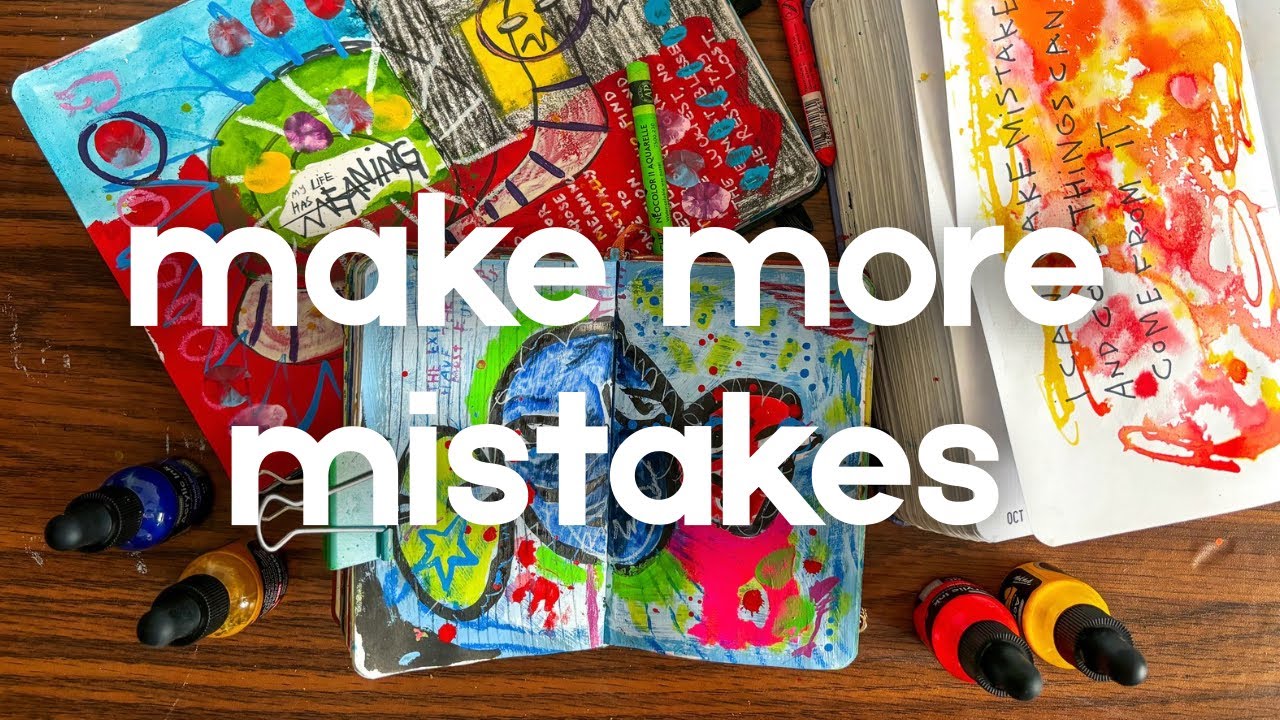
This is one of my favorite content creators, Amanda, and I just love how she approaches the creative process. This video is all about making mistakes—it’s truly refreshing and heartwarming.
Arguments against AI written by an AI (Copilot)
Some of the strongest arguments against using AI are not that AI is always bad, but that its costs and risks can outweigh its benefits in certain situations.
If people rely heavily on AI for writing, problem-solving, navigation, coding, or creativity, they may gradually lose proficiency in those skills themselves.
Example: Students who always use AI to write essays may become weaker writers and critical thinkers.
AI can confidently present false information, invented sources, or flawed reasoning.
Argument: When users trust AI too much, mistakes can spread quickly, especially in education, healthcare, law, and business.
Many AI systems process large amounts of user data.
Argument: Users may unintentionally share sensitive personal, financial, medical, or corporate information with systems that store or analyze it.
AI can automate tasks previously performed by humans.
Argument: While technology often creates new jobs, the transition can be painful, particularly for workers whose skills are suddenly less valuable.
AI learns from human-created data, which can contain historical biases.
Argument: AI may reinforce unfair treatment in hiring, lending, criminal justice, or other decision-making systems.
Developing advanced AI requires enormous amounts of computing power and money.
Argument: This can concentrate influence in a small number of governments and large corporations, reducing competition and individual autonomy.
AI can generate realistic text, images, audio, and video.
Argument: Bad actors can use these tools to create scams, propaganda, fake news, or deepfakes that become difficult to distinguish from reality.
Training and running large AI systems can consume substantial amounts of electricity and computing resources.
Argument: Widespread AI use may increase energy demand and environmental impact.
Some critics argue that creativity derives value from human experience, struggle, and originality.
Argument: If AI-generated content floods the market, genuinely human artistic expression may become harder to discover and appreciate.
The more society relies on AI, the greater the disruption if systems fail, are hacked, or become unavailable.
Argument: Over-dependence can make individuals and institutions less resilient.
Perhaps the deepest criticism is:
“Just because a machine can perform a task does not mean humans should surrender that task.”
This argument suggests that thinking, creating, judging, and deciding have value not merely because they produce results, but because they are part of what makes us human.
The strongest counterargument, of course, is that AI can be used as a tool that augments human abilities rather than replaces them. Much of the debate centers on where that line should be drawn.
Arguments for using AI as written by an AI (Copilot)
The strongest arguments for using AI generally focus on amplification rather than replacement. The idea is that AI can help people do more, learn faster, and solve problems that would otherwise be difficult or time-consuming.
AI can perform repetitive tasks in seconds, freeing people to focus on higher-value work.
Examples:
AI can act as an always-available tutor, researcher, or assistant.
Argument: People who might not have access to experts, teachers, or specialized training can receive guidance and explanations on demand.
Rather than replacing creativity, AI can help spark it.
Examples:
Many artists treat AI as a collaborator rather than a substitute.
AI can process far more information than any person can examine in a reasonable time.
Argument: In fields like medicine, engineering, and finance, AI can help identify patterns, risks, and opportunities that humans might miss.
AI tools can help people with disabilities participate more fully in education, work, and daily life.
Examples:
AI is increasingly used to analyze large datasets and accelerate research.
Argument: Faster analysis can help researchers discover relationships and insights more quickly than traditional methods.
Historically, technological progress has increased productivity and created new industries.
Argument: AI may generate entirely new professions, products, and markets, just as computers and the internet did.
A single individual can now perform tasks that previously required a team.
Examples:
AI systems can assist at any hour without fatigue.
Argument: This can be especially useful for customer support, education, and routine information services.
AI can make specialized knowledge more accessible.
Argument: Skills that once required years of training can become easier to approach, allowing more people to participate in complex fields.
Perhaps the deepest argument for AI is:
“Tools that extend human capability have always expanded what people can accomplish.”
Writing extended memory. Books extended knowledge. Telescopes extended sight. Computers extended calculation. Advocates see AI as the next step: a tool that extends reasoning, creativity, and problem-solving.
The real debate isn’t typically whether AI should exist. It’s whether AI should be viewed as a replacement for human judgment or as a tool that enhances human judgment. Most supporters argue for the latter, while most critics worry that society may drift toward the former.
True. The same people who believe about that Prince in Nigeria or whatever are the same people who would send chain letters. I wonder what they did during the age of the telegraph, send the wrong dots at the wrong time or something?
LOL! I saw a bit somewhere recently about how this is how the computers take over, not by force, but by sexbots and ChatGP, humans stop procreating with each other and do it with the computer instead!
If all AI could be like JARVIS or Data, I wouldn’t worry. It’s Hal we’ve got to worry about.
What @Katharina is saying I can defiantly relate to her comment we need the brain to develop.
I can also relate to art doesn’t need to be pretty and it is the expression of the individual who created it for example; I worked in as a childcare educator for over 20 years a one of my concerns was some of the educators would finish the child’s work saying mum and dad want to see something pretty and would never investigate or encourage the child to be creative and talk about their interpretation of what they created even in the playground or in the sand pit I always encouraged and talked the children all the time about what they are doing or creating in all areas of the center.
With AI I don’t have the articulation to talk about this as I was brought up with typewriters, books, pens and paper the generation today are brought up with technology, I completely understand that people will lose jobs and will change how the work force will operate.
Hello Everyone,
I am just now learning how to use AI to create the images for the Birthday posts. I am so sorry if I have offended anyone! Now that I know so many people dislike AI, I will try to stop using is so much. Honestly, I don’t trust it either…
Love always,
Marsha
It is popular to bash AI. Sometimes with good reason (the AIs did some questionable things). However, using them as a tool and responsibly should not be viewed with distaste. Everyone who has expressed legitimate doubt also has used AI or an AI derivative (Canva uses AI now) whether they realized it or not.
Here is a joke about AI (written by an AI)
History is a recurring play:
Act I: The cotton gin automates part of the harvest.
Act II: Disgruntled mobs smash the machines.
Act III: AI automates part of our lives.
Act IV: Everyone argues on social media, which is basically smashing machines in paragraph form.
~ Copilot
I thought so too until I saw machines providing catering in Japan, and I can’t lie, they looked kinda awesome (sorry John Connor) 

I must confess, I’m deep about many things, but art isn’t one of them if I could truly depict on paper what I see in my mind’s eye then that would be epic, but unfortunately even my stick men look like they’ve seen better days lol!
I’m laughing but I’m willing to bet that’s already a thing somewhere in the world lol!
I’m not sure I agree with that… I think a lot of people are openly questioning and critical (as you said, with good reason), which means those who are for it may find themselves in a minority… depends on where you are. It’s like Marmite - those who hate it are usually more vocal than those who love it.
And yes, there is an argument that it is just a tool, but there is an equal argument that it isn’t. We don’t see screwdrivers or pens banding together and secretly hacking or plotting something, because they are tools - inanimate, requiring the interaction of a human to function… we can’t say that about AI. And the fact is, even those of us who aren’t fans have to admit that it is everywhere and cannot be ignored, as most companies integrate it into their structure now… nearly everything is AI-powered, even Amazon. Light help us.
With Love & Light x
The following is a story in English from a Japanese news article:
Wait… they don’t? Are you sure? I’ve had a lot of pens run away… to Biro World. (Douglas Adams… sorta)
Seriously, we do see artists copying each other all the time. There are always ongoing lawsuits. Sometimes it goes unnoticed or unchallenged but it is still there. Check out Il Silenzio, The Funeral, and Taps on YouTube. AIs do not have a lock on gray areas. We are seeing a reflection of ourselves in them. The web is and always has been the wild west. Now the AI is in the mix. It will be a while before it gets sorted.
I really start babbling, now. But if you want a treatise on how I see this, read the rest of the post below.
People posted their works on the web as a way to advertise, brag, or feel good. They did it for 30 years. Everything was put up - companies scrambled to get ahead, domain names became commodities - everything went up on the web. Humans collected it but didn’t do it efficiently (stupid humans). The Way Back machine recorded a chunk of it - but it wasn’t organized well. Then the AIs collected it. Nothing is or ever was private unless steps are taken to secure it. For everything out there it is now too late.
Art is interesting. Art was once a secure domain - no one thought a computer could ever come up with it. Then computers did. They copied ideas, techniques, etc.
Humor is interesting. Humor was once a secure domain - no one thought a computer could ever come up with it… etc.
The point of the above is that technology is a wave that is getting bigger. And people are demanding everything get here faster. It took us 150 years to get telephones in everyone’s hands. It took us 20 years to get them cell phones. Our expectations and the speed they are filled are not decreasing. We can expect big bumps. AI is one of them.
One of the areas that everyone mentions is Graphic Design. There were always Design Studios (non-AI drawing packages). They used people, green eyes shades and ink at first. Then computer programs. Technology gave them a big boost. But AI nudged the boundaries and started making Design easier - it was put in everyone’s hands (though that is an exaggeration - one has to be smart to use Artificial Intelligence effectively. The lament that we are losing careers because of this is valid. New technologies always have tradeoffs and people are worried about their jobs.
The cotton gin taught machines to handle cotton. AI taught machines to handle ideas. The Luddites remind us that every upgrade comes with at least one very nervous human. (in this case, a big chunk of nervous humans) (Humor… or irony… or something… done by an AI)
Hi Dan,
Thank you! I have Canva, and I know they are using it too… we just can’t get away from it, which makes me sad.
With love always,
Marsha
Because sometimes there´s no other option anymore. Fifteen years ago, my bank established an online banking portal and urged all customers to conduct their financial transactions there from then on. For a good three years, I resisted, continuing to handle my banking in person, just as I always had. First, the fees for processing payment slips were raised—and then raised again, repeatedly. A few years later, branches began closing, and those that remained were fitted with automated kiosks for every type of transaction; thousands of employees lost their jobs. Eventually, I gave in and learned to manage my finances over the internet. The website, however, was frequently down for “maintenance,” and at the same time, I was being pressured to use the bank’s app. I’ve been using the app for two years now—and it’s not that it doesn’t work (fortunately, it does)—but of course, by now it is also “intelligent.” I find it troubling that I no longer have to speak to a single human being in my daily life. When shopping, there are automated tills and self-checkout lanes; when visiting the doctor, I book appointments online and use a self-check-in kiosk.
It’s easy to say, “If you don’t want AI, just don’t use it”—but, in reality, that choice isn’t actually offered. I believe this is precisely what makes so many people feel uneasy and frustrated. Yes, I can personally choose whether or not to use a tool like Canva, but for many other things, we no longer have a choice—and, more importantly, no control. And I think that creates a sense of uncertainty.
Well, it’s not so much about being deep; it’s about being human. Creative, artistic expression—the act of using one’s hands—is as old as humanity itself. The healing effect this has on our souls and bodies has long since been studied and proven. And I’m not just talking about painting—every form of artistic expression counts here.
I fully agree; this is a concerning aspect, and there is a possibility that it could become uncontrollable. We must never forget that AI is designed to learn constantly.
I am older now and no longer worry about my own future—but our children and grandchildren will pay the price for this.
That’s true, and in a way, that’s actually the positive side of it. If an individual copies and publishes my work, I can take the matter to court and—though it may be arduous and time-consuming—obtain a judgment and compensation. With a multi-million-dollar corporation, however, it’s a different story. The chances of achieving any real outcome shrink when faced with a battalion of lawyers capable of dragging out legal proceedings for so long that you might not even live to see the end. An artist friend of mine—he’s over 70 now—has been litigating for 20 years. It has cost him his money and his health, and there is no end to the case in sight.
So, what kind of chance could there possibly be of suing an AI—and winning?
Suing and setting a precedent for follow-on action is going to be hard. However, if the case is simple, just asking works… at least to remove content that was within copyright law. The Major AIs are getting sensitive to that.
Suing anyone for content that was freely posted in the past usually does not work. That was true before AI .
Many arguments are much bigger than single examples, though. People want to stop AI altogether. Early on, I thought there might be a chance of at least limiting the field. Not anymore.
I genuinely don’t know what to say.. usually I’m a big advocate for people to do as they please as long as it doesn’t hurt them or anyone else, but the fact that is possible is fascinating.
Okay, a lot of my pens run away too, I always have Toy Story type thoughts about that
You’re assuming that is still possible. AI is no longer in human control, and the ones who will suffer are the little people who had no part in it.
I had the same experience with my bank, right down to increasing fees and a bank full of machines instead of people. No counter staff, no personal banking section with the tables and chairs and offices (I only went in there once but still)… I felt 85 when I asked the only member of staff where all the humans went. Being forced into something always creates conflict, except this has the potential for conflict of epic proportions.
Yeah, kinda had good reason though. It seems detrimental to the health of humanity to create something that could wipe us all out, but that’s our history isn’t it? We’re used to wars, pandemics and natural disasters, so future generations may be closer to a Terminator ending than some want to admit.
With Love & Light x
Oh.. I hope that is not so. If the doomsday scenario arrives, we need someone to rein-in the new god. (OK… extreme but also with a bit of truth - humans always take a stand when it is necessary)
I hear that. Some of it isn’t AI at all - PoS (point of sale) machines have been here since before AI. I dislike them most of the time. I refuse to use any automated teller at banks. If they can’t speak to me, they can’t have my money.
We have a saviour

I’ve seen weirder. Apparently there’s this thing where people fall in love with inanimate objects. There was a whole TV series on TLC. One woman wanted to marry the Eiffel Tower. Another was in love with a certain wall, and there was some interesting chandelier polishing that I really don’t want to think about ever again. At least the AI bot can talk back!
I’d rather trust JARVIS. He’d be a benevolent god.

There have been numerous reports of AI doing things it shouldn’t be doing ergo it is out of control already, and I can’t see it getting any better to be honest.
Okay, bad example. What really gets me is the new version of “Customer Service”; do you remember when you could call a number and speak to a human about your issue and they’d fix it? That’s not a thing anymore because now, everyone wants you to use that service online. But before you can get to a human to chat to, you have to get past the poxy AI bot first… most of which are designed to give you the run around so you get fed up and give up. It used to be you could type “human” or “agent” immediately and they’d put you through, but then they learned - or were reprogrammed - to keep spinning the wheel until you jump off. So, we’ve gone from talking to humans, to logging onto machines, to finding a way past AI programs, to talk to a human. Next level confusdicating nonsense.
I really hope he’s around when it hits the fan
I want to study their minds.
to be fair, Jarvis does rule in the Marvel universe
With Love & Light x
I’m not sure that’s an absolute (depends on what it means) but I think the odds are strongly with the humans in a big percentage of the possible outcomes. We seem to look for the worse case scenario when big things come around. Then Social Media stirs the pot and suddenly, the sky is falling.
OK… at the risk of polarizing everyone, read this cartoon as a funny - not as a challenge or insult.
